

Understanding a disposable THC cannabis vape starts with knowing what the information on its label means. This guide from Fire & Oak Mount Holly examines Dice’s Banana Kush, Apple Fritter, and Maui Wowie 1g listings to explain product weight, THC percentages, and terpene data.
Readers following Fire & Oak’s educational content can also find its Burlington website. When researching a dispensary or searching for “dispensary near me,” understanding product information adds useful context beyond the search results.
A product name, a percentage, and a device format each answer a different question. Reading them separately helps clarify what a listing actually documents—and which details require the original packaging or a laboratory report.
A product listing combines several kinds of information. The brand identifies the company associated with the product, the name distinguishes the listing, and the size indicates the stated quantity. Cannabinoid and terpene fields describe aspects of its composition.
The word “disposable” identifies the device format. It does not establish the extraction method, ingredient list, or whether the contents are distillate, live resin, or live rosin. Those descriptions require their own supporting information.
Packaging also matters. The New Jersey Cannabis Regulatory Commission’s packaging and labeling guidance addresses the disclosure of other inactive or excipient ingredients and encourages manufacturers to identify extraction methods for concentrates. A short menu description may not reproduce all that information.
The following examples share a brand and stated size, while their reported cannabinoid and terpene figures differ.
Product figures reflect the listings reviewed on October 14, 2026. Values can differ between batches.
The Dice Banana Kush Disposable 1g appears in the catalog as an indica disposable, with 85.66% THC and 7.93% terpenes. Its stated size is 1g.
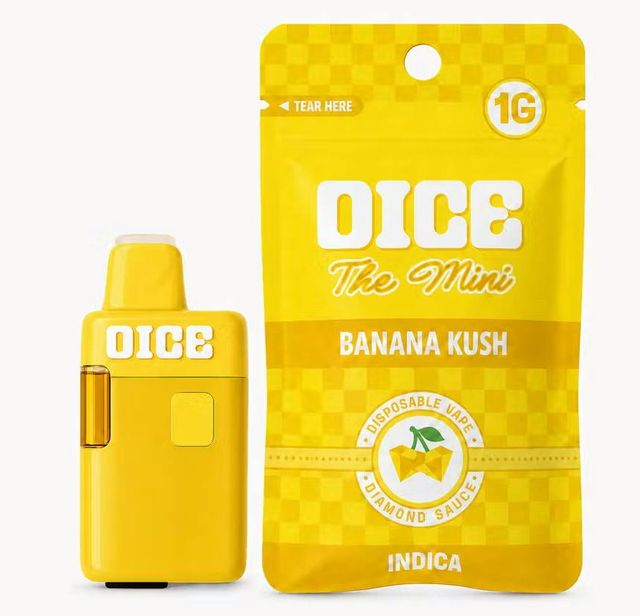
These fields identify the listing and summarize reported measurements. The name “Banana Kush” does not, by itself, establish banana-derived ingredients or identify individual terpenes. Those details would need confirmation from the ingredient statement and any available terpene analysis.
The Dice Apple Fritter Disposable 1g reports 85.55% total THC and 8.36% total terpenes, with a stated size of 1g.
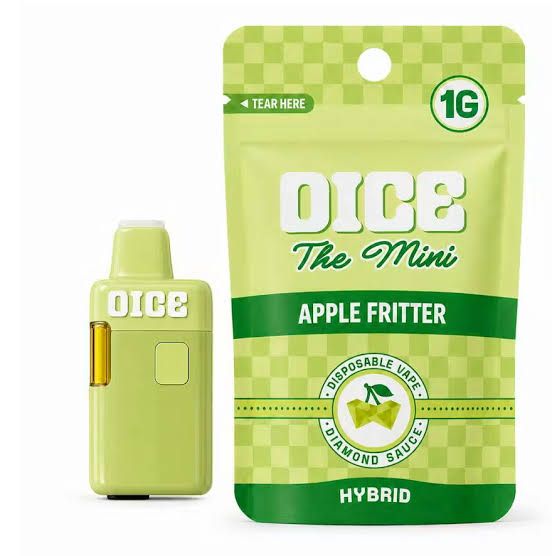
The terpene figure is an aggregate measurement. It does not identify which compounds account for that total or how much of each compound is present. A detailed profile would need to list the individual terpenes and their concentrations.
The Dice Maui Wowie Disposable 1g reports 84.96% total THC and 7.73% total terpenes, also in a 1g disposable format.
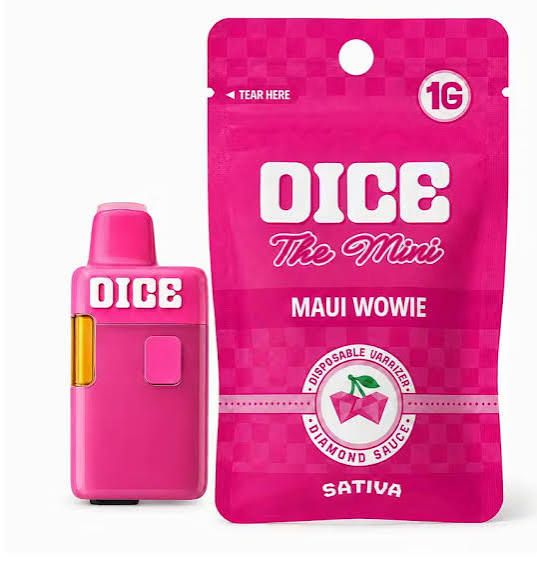
The displayed information establishes its size and reported composition. It does not document battery capacity, charging compatibility, or a guaranteed number of inhalations. Those are separate hardware details that cannot be inferred from the 1g designation.
The numbers on a listing become more useful when their units and definitions are clear.
One gram equals 1,000 milligrams of material. A 1g product designation therefore does not mean that the product contains 1,000 milligrams of pure THC.
Weight describes quantity. A percentage describes a proportion of the tested material. Keeping those measurements separate prevents a common misunderstanding: treating the size printed beside a product name as its cannabinoid content.
The stated weight also does not establish how long a device will last. It provides a quantity, not a fixed duration.
“Total THC” and “delta-9 THC” are not automatically interchangeable label terms.
The NJ-CRC’s labeling guidance defines total THC using the following calculation:
Total THC = (THCA × 0.877) + delta-9 THC
The calculation accounts for THCA’s potential contribution after conversion to THC. This is why the heading attached to a percentage matters: a total THC result may differ from a measurement of delta-9 THC alone.
When reviewing a label, retain the terminology used in the report. Replacing “total THC” with a different cannabinoid measurement can change the meaning of the number.
The NJ-CRC glossary describes terpenes as compounds associated with the aroma and flavor of cannabis and other plants.
A total terpene percentage combines reported terpene measurements into one figure. It does not identify the individual compounds, their relative proportions, or their source.
For example, two products could report similar terpene totals while containing different mixtures. An aggregate number cannot show that distinction. Likewise, a product name containing a fruit or dessert reference is not a substitute for an ingredient list or a detailed chemical profile.
A certificate of analysis, often called a COA, provides laboratory information for a tested sample. The NJ-CRC guide to reading a certificate of analysis explains the report’s main sections and states that consumers can request a product’s COA from a dispensary.
When reviewing a report, check:
A matching brand or product name alone is insufficient to establish that a report covers a particular package. The batch information provides the more specific connection.
Yes. The Banana Kush, Apple Fritter, and Maui Wowie listings reviewed for this article each identify a 1g disposable format. Their reported THC and terpene percentages differ.
No. “Disposable” describes the device format. The extract type must be identified separately in the product documentation; it cannot be established from that word alone.
No. It provides a combined figure. Identifying specific terpenes requires a breakdown that names the measured compounds and reports their concentrations.
No. Local search results do not establish a particular product’s ingredients, extraction method, or batch composition. Those details require product-specific documentation, such as the packaging, manufacturer information, and a matching laboratory report.
Reading a disposable THC cannabis vape listing involves connecting several pieces of information: the product’s identity, its stated weight, the meaning of each percentage, and the documentation for the relevant batch.
The Dice examples illustrate why those fields should remain distinct. A product name identifies a listing; a percentage reports a measurement; a laboratory report supplies additional context.
For broader guidance, the NJ-CRC’s safe and responsible consumption resource covers reading package information, keeping cannabis away from children and pets, and avoiding impaired driving. Understanding a label is one part of understanding the product and its risks.